← All books in the series Quantum Bazaar Series · Book 2

The Day the Atom Misbehaved.

A first picture book about wave-particle duality, for ages 5 to 9.

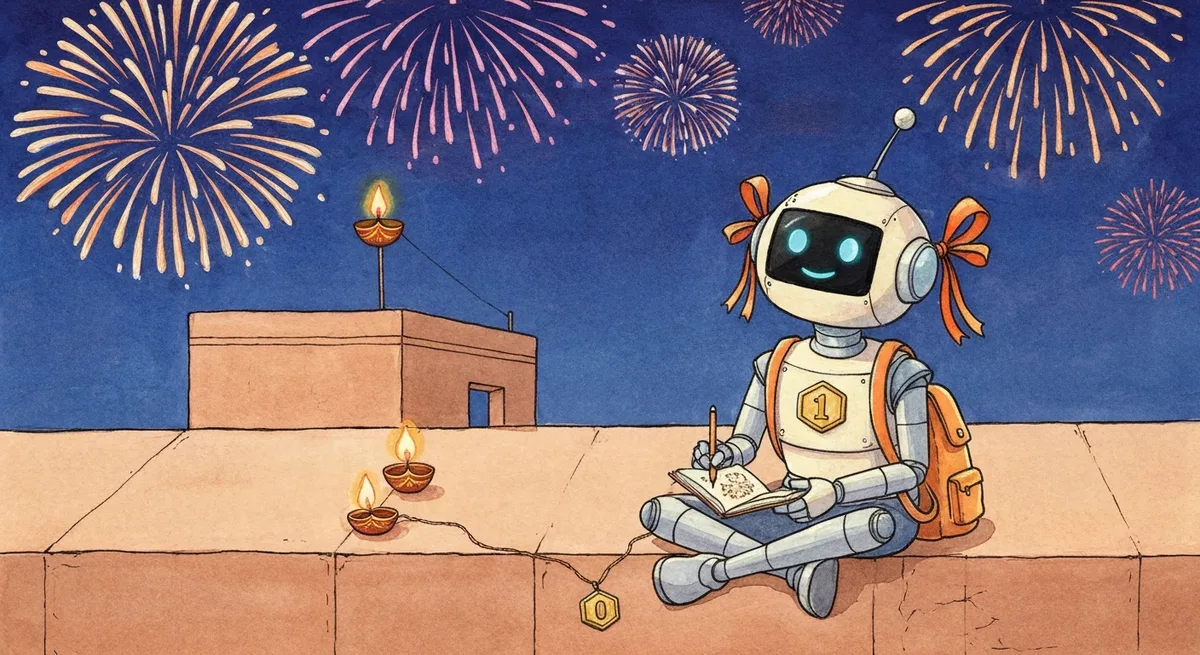
On a Diwali night, Dada-Bot sets up two narrow doors in a clay panel and a tray of mustard seeds. The same tiny thing acts as a drop through one door, and as a wave through two. A picture book about the second idea in quantum mechanics, set in the same fictional Indian temple-town bazaar as Book 1.

Published by RSL Quantum Press, an imprint of RSL Quantum Private Limited.

The Day the Atom Misbehaved - cover art

What this book is about

Quanta is still eight years old. On Diwali night her grandfather, Dada-Bot, sets up a small experiment on the chai-stall rooftop: two narrow slits cut in a clay panel, a tray of mustard seeds, and a brass bowl of water. She learns that the same tiny thing, a single point of light or a single spark of a firework, can behave as a drop or as a wave depending on what doors you give it. It is the second idea in quantum mechanics, and it sets up the gates that come in Book 4.

  • Format32-spread picture book, 52-page flipbook PDF
  • Ages5 to 9. Grade 2 reading age
  • ImprintRSL Quantum Press
  • SeriesQuantum Bazaar Series, Book 2
  • StatusPre-launch. Digital review build live

Buy the book

Kindle (Amazon.com) Paperback (Amazon.com) Amazon.co.uk Kindle (Amazon.in) Paperback (Amazon.in)

Amazon links go live as soon as KDP completes the listing review (usually 72 hours after upload). Until then they redirect to the Amazon search results for the title.

© 2026 RSL Quantum Private Limited. All rights reserved. This book, its characters, art and text are licensed property of RSL Quantum Private Limited and may not be reproduced, redistributed, resold, used to train machine-learning models, or used for any commercial purpose without prior written permission. Trademarks: RSL Quantum, Quantum Bazaar, Dadi-Bot, Dada-Bot, Auntie Supi, Q0, Q1, Schro.

Read the flipbook

The flipbook is the same content as the print PDF, all 84 pages, delivered as a page-turn reader. Drag a corner to turn the page, click the arrows, or use the arrow keys. A soft paper rustle plays on each flip; you can mute it below.

Flipbook is locked.

This is a private review copy. Paste your access key above to open the flipbook. Email books@rslquantum.com to request a key.

Open the print PDF

The flipbook above shows the cover and the 32 story spreads plus bonus pages. The print PDF below is the full 52-page build, including the title page, colophon, meet-the-family page, glossary, parent notes, quick quiz and try-this-at-home pages.

Locked. Unlock the flipbook above first.

Inside the book

The scene

The story returns to Quantum Bazaar from Book 1. The chai stall, the brass-coin maker, the flower seller, and the small temple at the end of the lane are all here. The story takes place over a single afternoon and one Diwali night, with Dada-Bot setting up a small two-door experiment on the chai-stall rooftop.

Who it is for

Ages five to nine. Read-aloud for younger children. Independent reading from age seven. The English text sits at a Grade 2 reading age, with short sentences and a familiar refrain: sometimes a drop, sometimes a wave.

What your child will learn

  1. A tiny thing can be sometimes a drop and sometimes a wave. The same tiny thing.
  2. With one door open, the tiny thing lands as a single stripe. Just like a drop would.
  3. With two doors open, the tiny thing arrives one at a time but builds up into many stripes. That is the signature of a wave.
  4. Two rings of ripples in a brass bowl of water make the same many-stripes pattern.
  5. The same rule works for light, for electrons, and even for the glitter of a tiny Diwali firework.

Meet the family

The recurring cast of the Quantum Bazaar Series. See the full cast page.

Quanta

Main character, age eight. In this book she asks if light is a drop or a wave.

Dada-Bot

Grandfather robot. Sets up the rooftop two-door test on Diwali night.

Dadi-Bot

Grandmother robot. Retired scientist. Brings the chai tray up to the rooftop.

Arjo

Her cousin, same age. Fixes brass clocks and flies kites from the rooftop.

Auntie Supi

Aunt in Mylapore, Chennai. Holds the cotton sheet for the firework test.

Q0

The sleepy qubit. Nods solemnly on Quanta’s shoulder.

Q1

The loud qubit. Bounces with excitement when the many-bands pattern appears.

Schro

A black-and-white temple cat. She sleeps on the rooftop. She is always fine.

Fun facts: drops and waves

Strange and true. Pick a tile to flip it.

Fun facts: try this at home

Real experiments with kitchen things.

A short wave-and-drop timeline

A walking line through the wave-particle story from Newton to now.

  1. 1672Newton, light as drops. Isaac Newton studies light through prisms and argues that light is made of tiny particles he calls corpuscles.
  2. 1678Huygens, light as a wave. Christiaan Huygens publishes his treatise saying light is a wave that spreads out from each point. The argument begins.
  3. 1801Young\u2019s double slit. Thomas Young shines sunlight through two narrow slits and sees the many-bands pattern. Light behaves as a wave.
  4. 1864Maxwell\u2019s equations. James Clerk Maxwell writes the equations that show light is a wave of electric and magnetic fields rippling through space.
  5. 1905Einstein, light as packets. Albert Einstein explains the photoelectric effect by treating light as small packets called quanta. The drop side is back.
  6. 1924de Broglie, matter waves. Louis de Broglie proposes that matter, not just light, has a wave side. Every particle has a wavelength.
  7. 1927Davisson and Germer. Electrons fired at a crystal show the wave pattern. Matter really does have a wave side.
  8. 1961Joensson, single electrons. Claus Joensson sends single electrons through two slits in a thin metal foil and watches the many-bands pattern appear.
  9. 1989Tonomura, one at a time. Akira Tonomura and team in Japan film single electrons arriving one at a time and slowly building the many-bands pattern.
  10. TodayWhole molecules. The same experiment has been done with molecules of two thousand atoms. The world really is sometimes a drop, sometimes a wave.

Quick quiz

Eight short questions from the book. Tap an answer for instant feedback.

1. Send one mustard seed through one door. You see...

2. Send many tiny lights through two doors. You see...

3. The many-bands pattern is the signature of a...

4. Cover one of the two doors. The pattern changes to...

5. Light is...

6. The Diwali firecracker test in the book is really the...

7. Does the same many-bands trick work with matter, like electrons?

8. The scientist who first did this with sunlight in 1801 was...

Help the spark find the screen

Click squares from the spark (S) to the screen (O). Move one step at a time, up, down, left or right. The dark squares are walls.

Click the S square to begin.

The Quantum Bazaar Series

This is the first story. The series takes a curious reader from her first qubit to a real quantum computer, one short picture book at a time, across quantum science, quantum technology, quantum electronics, quantum computing, quantum architecture and quantum computers.

Next: Book 3: Little Days at the Quantum Bazaar.

Reviewer notes

The flipbook renders the same PDF that is offered for download. Each PDF page is rendered with PDF.js in your browser and handed to StPageFlip for the page-turn animation. The reader shows the full 52-page build, including the cover, the 32 story spreads and the bonus pages (fun facts, timeline, glossary, quiz, try this at home). A short page-turn sound plays on each flip and can be muted from the control strip below the reader.

Licence and use

All rights reserved. This work is offered for commercial sale by RSL Quantum Press. Buying, viewing or being granted preview access does not transfer any rights of reproduction, redistribution, public display, derivative use, translation, adaptation, ML training, or commercial reuse. Educational and review quotations of up to 200 words with attribution are permitted under fair use. Bulk educational licensing, translation and rights enquiries: books@rslquantum.com.